This website is not optimized for Miscrosoft Internet Explorer and Miscrosoft Edge !
Screening / Screening / Screening / Screening /
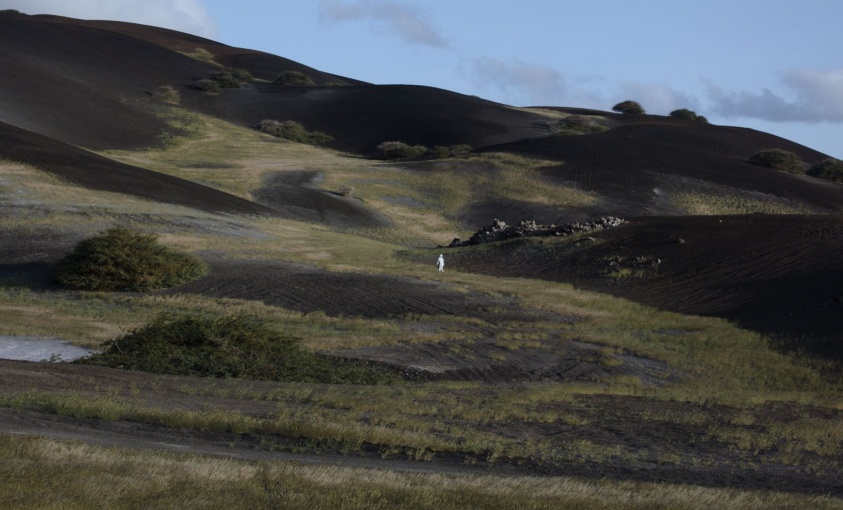
© 2023 TerraForma — Courtesy of Silverstrand Productions
Screening
Terraforming: Historical Vision, Stakes, and Limits
As part of the "Here Comes the Sun: Art, Energy and Natural Intelligence" exhibition
TerraForma IR 2023, 62 min, Kevin Brennan, Laurence Durkin
TerraForma tells the remarkable story of Ascension Island, a remote volcanic outcrop in the South Atlantic Ocean that emerged from the sea just over a million years ago a geological infant in Earth's 4.6-billion-year history. Located approximately 1,600 kilometers from the nearest landmass, this barren island sat largely lifeless for millennia a stark landscape of volcanic rock and ash with minimal vegetation, earning it the nickname "cinder island" from early mariners. Its youth meant that life had barely begun to establish itself when humans arrived.
Discovered by the Portuguese on Ascension Day in 1503, the island remained uninhabited until the British established a naval garrison there in 1815, following Napoleon's exile to nearby Saint Helena. What followed was one of history's most ambitious ecological experiments. When Charles Darwin visited in 1836 aboard HMS Beagle, he was struck by the island's barren desolation and suggested it should be made into a "productive spot." Seven years later, in 1843, botanist Joseph Hooker visited and, encouraged by Darwin's vision, developed an ambitious plan to transform Ascension's barren peak, Green Mountain, into a lush garden. Beginning in 1847, Hooker who would later direct the Royal Botanic Gardens at Kew, arranged for ships to bring plants, trees, and seeds from across the Empire eucalyptus from Australia, bamboo from Asia, Norfolk pines from the Pacific creating an entirely artificial ecosystem on the island's summit.
This Victorian-era 'terraforming' project reshaped the island's ecology to fit the political and economic demands of the British Empire establishing a verdant supply station for ships and a symbol of imperial power over nature but only at the expense of what existed before it. The new environment, seemingly a paradise, was in fact a mirage: a mirror image of Victorian ambition, empire, and understanding of the natural world. And as such, it was doomed to fail in unexpected ways. Many believe that future plans to geo-engineer our planet, or terraform others, would simply follow the same pattern.
With the help of experts in the fields of geo-engineering, ecology, politics, and design, the documentary TerraForma explores the lessons we could learn from Ascension Island's unique history. What does its story mean for our planet in a future where terraformed landscapes and human-engineered environments may come to warp our understanding of 'nature' itself?
The screening will be followed by a conversation with directors Kevin Brennan and Laurence Durkin, moderated by Charles Rouleau, Coordinator of the Casino Display – Space for Artistic Research. They will be joined by Fabienne Groß and Louise Daniel, Master of Architecture students at the University of Luxembourg, whose work engages closely with the implications of terraformation.
Free entry, registration required

Organisation
Cercle Cité, in collaboration with the LUCA - Luxembourg Center for Architecture
With the support of
the Ministry for the Environment, Climate and Biodiversity
Partners
LCCF
Around the event
06/02/2026
-
05/04/2026
11:00
-
19:00
Ratskeller exhibition space (rue du Curé)
Exhibition opening 05.02.2026 - 18:00
Exhibitions
Here Comes the Sun
Art, Energy and Natural Intelligence
Organized by Cercle Cité with the support of the Luxembourg City Film Festival and the Ministry for the Environment, Climate and Biodiversity
26/02/2026
18:00
-
19:30
Henri Beck Auditorium (2, rue Genistre)
Lectures
The Sun in Cinematic Imagery
by Yves Steichen
Organized by Cercle Cité, in collaboration with the CNA
13/03/2026
12:30
-
13:45
13/03/2026
19:30
-
20:45
Cercle Cité (main entrance Place d'Armes)
Music
Chef meets Chef - music & cinema
In Search of the Lost Original Soundtrack
Organized by Cercle Cité and the "Orchestre de Chambre du Luxembourg"
04/04/2026
10:00
-
11:30
Conference center (2, rue Genistre)
Workshops
Drawing the invisible: discovering radiolarians
As part of the "Here Comes the Sun: Art, Energy and Natural Intelligence" exhibition
Organized by Cercle Cité